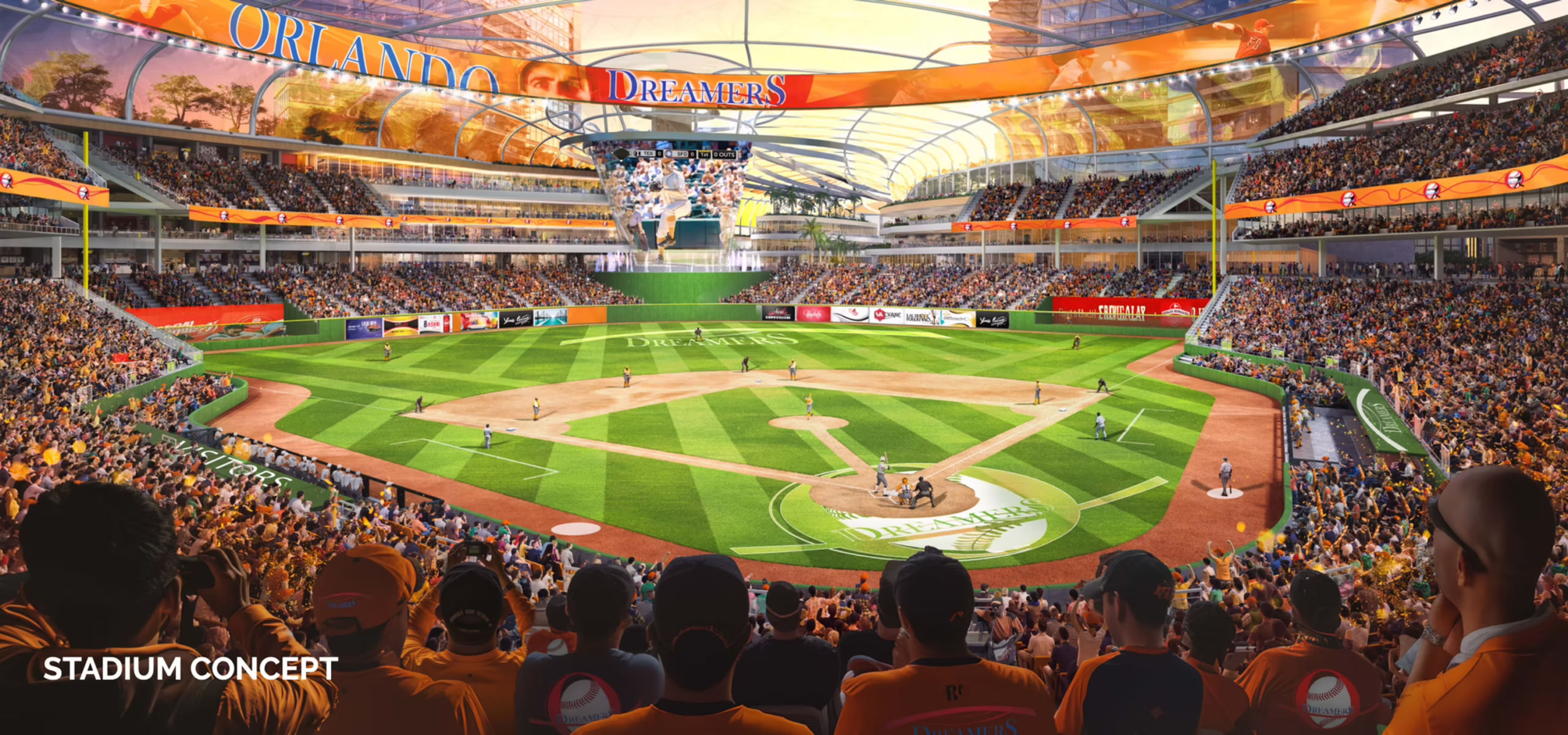

The Orlando Dreamers’ original stadium concept has grown into a proposed $2 billion public-private development play that could reshape one of Central Florida’s most valuable tourism corridors.
By Extended Reach USA
Strip away the uniforms, the franchise speculation and the promise of summer nights under a domed roof, and Orlando’s pursuit of Major League Baseball becomes something much larger than a sports story.
It is a commercial real estate story.
The Orlando Dreamers are proposing a 45,000-seat domed stadium and surrounding entertainment district on approximately 35.5 acres near International Drive and State Road 528, north of Aquatica and close to SeaWorld Orlando and the Orange County Convention Center. The site sits inside one of the most heavily visited tourism districts in the United States, surrounded by hotels, attractions, restaurants and major transportation corridors.
The concept was initially presented in 2023 as a $1.7 billion mixed-use development containing the stadium, retail, restaurants, office space, hotel towers with as many as 1,000 rooms and a separate performance venue. The Dreamers sought $975 million in Orange County Tourist Development Tax funding toward that original plan.
Three years later, the scale and financial language have changed.
In July 2026, the Dreamers submitted another request for $975 million in tourist-tax funding, while current reporting describes the stadium component as a roughly $2 billion proposal. The organization says it has more than $1 billion under letters of intent for stadium financing and more than $2 billion in combined commitments for the acquisition of a team and stadium financing.
That makes the question facing Orange County considerably larger than whether Orlando should have a baseball team.
The real question is whether the county should use nearly $1 billion in tourism-generated public revenue to help establish an entirely new commercial district around a major sports venue.
Use: Wide aerial rendering of the complete stadium and surrounding development at sunset.
Caption: The Orlando Dreamers’ original concept places a domed Major League Baseball stadium within a larger hospitality, entertainment and mixed-use district near International Drive and State Road 528. Conceptual rendering courtesy of Orlando Dreamers.
Alt text: Aerial conceptual rendering of the proposed Orlando Dreamers baseball stadium and mixed-use entertainment district near International Drive.
A Stadium Designed as an Orlando Attraction
The proposed stadium is not being positioned as a traditional ballpark surrounded by parking lots.
The Dreamers describe a roofed venue designed to allow natural light into the building while protecting games and events from Central Florida’s heat and frequent summer storms. The approximately 45,000-seat bowl would emphasize sightlines, acoustics, premium seating and a more intimate experience despite its relatively large capacity.
That roof is not a small detail.
An open-air stadium in Orlando would face weather risks throughout much of the baseball season. A climate-controlled or weather-protected venue gives the building a better chance of operating consistently—not only for baseball but also for concerts, conventions, corporate gatherings and other ticketed events.
For commercial real estate investors, that expanded calendar matters. A venue that operates throughout the year can create more predictable demand for nearby restaurants, hotel rooms, retail tenants, transportation services and event-oriented businesses.
The stadium would be the anchor, but the business model depends on the district functioning when the team is not playing.

More Than a Ballpark
According to the Dreamers’ concept, the surrounding district could include five-star hotels, boutique shopping, restaurants and cultural destinations such as art, music and history museums. The site is also being envisioned for concerts, conventions, political events, community gatherings, farmers markets and international baseball events.
That mixed-use component may ultimately be more consequential to International Drive than the stadium itself.
Hotels would add room inventory and potentially establish a new premium lodging cluster near the convention center. Restaurants and entertainment operators would gain access to baseball crowds, convention visitors, theme-park tourists and local residents. Museums and public gathering spaces could create daytime traffic that a sports venue alone would struggle to generate.
The challenge will be producing an authentic district rather than another collection of inward-facing attractions.
Successful stadium districts create streets and public spaces people use even without a ticket. They depend on walkability, shade, pedestrian connections, active storefronts and a tenant mix capable of serving residents as well as visitors. A district that functions only before and after games would leave a considerable amount of valuable real estate underused.
Orlando already knows how to build attractions. The more difficult assignment will be building a neighborhood.

The International Drive Location Is the Real Estate Play
The preferred site sits at the intersection of International Drive and State Road 528, placing it near the Orange County Convention Center, Aquatica, SeaWorld and one of the largest concentrations of hotel rooms in Central Florida.
That location gives the proposal an advantage many competing stadium plans do not have: an existing tourism economy.
The Dreamers are not attempting to create regional visitation from nothing. They are trying to insert baseball into a market where millions of travelers already arrive, sleep, dine and spend money.
The organization identifies Orlando as the country’s 15th-largest media market and argues that it will soon become the largest American television market without an MLB franchise. The Dreamers also point to Orlando’s approximately 80 million annual visitors and record tourism-tax collections as evidence that the region can support a major-league venue. Those market and attendance projections come from the Dreamers and should be evaluated as part of the group’s advocacy case rather than treated as guaranteed outcomes.
Visit Orlando has endorsed the effort, arguing that a flexible venue capable of hosting sporting events, meetings, conventions and community programming could complement the region’s existing tourism offerings.
From a commercial real estate standpoint, the district could create several layers of opportunity:
New hotel development could capture baseball travel, conventions and special events. Restaurant and entertainment tenants could gain a new stream of evening activity. Nearby parcels could become more valuable for hospitality, retail and experiential uses. Infrastructure improvements could make additional development possible across the surrounding corridor.
But none of those outcomes happen automatically. They depend on the stadium attracting a team, the surrounding development being completed, the district remaining accessible and the venue generating enough activity outside the baseball calendar.

The Economic Case—and the Necessary Caution
The Dreamers recently released an updated economic-impact study prepared by JLL. According to the organization, the project could support more than 38,000 jobs during construction, produce more than 52,000 permanent jobs, generate more than $72 billion in economic activity over 30 years and create an average of $32 million in additional annual Tourist Development Tax revenue.
Those are enormous numbers, and they form the core of the group’s argument for public participation.
The Dreamers have also proposed using team and stadium revenue to support transportation and workforce-housing initiatives, while building lighted youth baseball and softball fields throughout Orange County. The group says private investors would pay the substantial majority of construction costs and that Orange County would own the completed stadium.
These projections deserve attention, but they also deserve independent scrutiny.
Economic-impact studies model what may happen under specific assumptions involving attendance, visitor spending, construction activity, event bookings, hotel demand and the amount of money entering the local economy from outside the region. A projection is not the same as a contractual guarantee.
Orange County will need to understand which portions of the projected activity represent genuinely new spending, which portions could be redirected from existing attractions and what happens if development costs, attendance or the timing of an MLB franchise differ from the assumptions.
The most important figures may not be the headline totals. They may be the underlying revenue-sharing agreements, development obligations, performance requirements and protections negotiated between the Dreamers and the county.
The Nearly $1 Billion Public Decision
Orange County’s Tourist Development Tax is a 6% tax applied to hotel stays and other short-term accommodations of less than six months. State law limits how the revenue may be used, and a county advisory task force is reviewing proposals for future unallocated funds before making recommendations to elected officials.
The Dreamers’ $975 million request would represent one of the largest public commitments ever made toward a Central Florida sports facility.
That scale has already produced caution among county officials.
Orange County Commissioner Mayra Uribe warned that committing nearly $1 billion could limit the county’s ability to support other projects for much of the next decade. Commissioner Michael Scott has expressed support for the baseball effort while also emphasizing the need to balance the proposal against the broader public interest.
That tension is reasonable.
Tourist-tax dollars are not the same as general property-tax revenue, but they are still a limited public resource. Committing them to one project creates an opportunity cost, even when the project promises to replenish the tourism economy.
Orange County must decide whether the stadium would become an engine that expands future collections or an obligation that consumes years of available capacity.
What Must Be Answered Before the First Pitch
The proposal still faces several fundamental uncertainties.
No Major League Baseball franchise has been awarded to Orlando. Public approval would strengthen the city’s bid, but it would not guarantee expansion or relocation. The Dreamers themselves describe local funding approval as a signal to MLB that Orlando is prepared to compete with other prospective markets.
The county must also determine how the land would be controlled, how the surrounding development would be phased, which party would be responsible for cost overruns and what would happen if a franchise were delayed or never awarded.
Transportation may be equally important. A stadium and entertainment district capable of holding tens of thousands of people cannot be treated as an isolated building. Its success would depend on roadway access, transit, pedestrian movement, parking strategy and connections to hotels and attractions throughout the tourism corridor.
Workforce housing commitments will also need detail. Promising to support housing is different from establishing a defined funding mechanism, location strategy and measurable production target.
These are not reasons to dismiss the project. They are reasons to structure it correctly.

Orlando Is Betting on More Than Baseball
The Orlando Dreamers’ proposal arrives at a moment when Central Florida is attempting to define what its next generation of growth will look like.
The region is no longer simply adding theme-park capacity and conventional hotel rooms. It is pursuing entertainment districts, transit-linked development, corporate investment, advanced industries and projects designed to keep visitors in the market longer.
A Major League Baseball stadium could become another anchor in that evolution.
It could create a year-round destination near the convention center, attract private development and give Orlando another nationally visible institution. It could also consume nearly $1 billion in public tourism funding before the city knows whether MLB will actually place a team there.
That is the bet.
The concept art shows an extraordinary building. The economic study describes an extraordinary return. The location presents an extraordinary commercial opportunity.
Orange County’s job is to determine whether the contracts, financing and development obligations are strong enough to turn those extraordinary promises into real property, real businesses and lasting economic value.
Because this proposal is not ultimately about whether Orlando loves baseball.
It is about what Orlando is willing to build—and what it is willing to spend—to become a major-league real estate market.


