
Artemis II Delivers Historic Images and Powerful Message from Deep Space as Humanity Returns to the Moon

For the first time in more than 50 years, humans are once again traveling beyond low Earth orbit—and Artemis II is already redefining how we see our place in the universe.
Launched on April 1, 2026, from Kennedy Space Center, NASA’s Artemis II mission has entered a critical phase of its journey, with the crew now deep into space on a historic lunar flyby mission.
As of this week, the Orion spacecraft is more than halfway to the Moon, marking one of the most significant milestones in human spaceflight since the Apollo era.
A Mission Beyond Orbit—And Beyond History
Artemis II is the first crewed mission to travel this far from Earth since 1972, carrying four astronauts aboard the Orion spacecraft on a free-return trajectory around the Moon.
The crew includes:
- Reid Wiseman (Commander)
- Victor Glover (Pilot)
- Christina Koch (Mission Specialist)
- Jeremy Hansen (Canadian Space Agency)
This mission is not just symbolic—it is a full systems test for deep space travel, validating life support, navigation, and communications systems before future lunar landings.
Stunning Images from the Crew (A New “Blue Marble” Era)
Earth from Orion – A New Perspective

The Artemis II crew has already released breathtaking images of Earth from deep space, capturing views rarely seen by human eyes.
- One image shows Earth with auroras visible at both poles and faint zodiacal light from the sun
- Another reveals the planet as a glowing blue sphere surrounded by darkness—echoing the iconic Apollo-era “Blue Marble” photo
- Additional shots capture Earth in partial darkness, illuminated by city lights and a thin crescent of sunlight
These images are not just beautiful—they are historically significant, marking the first time in decades that humans have photographed Earth from this distance.
Inside Orion – Life Between Earth and the Moon


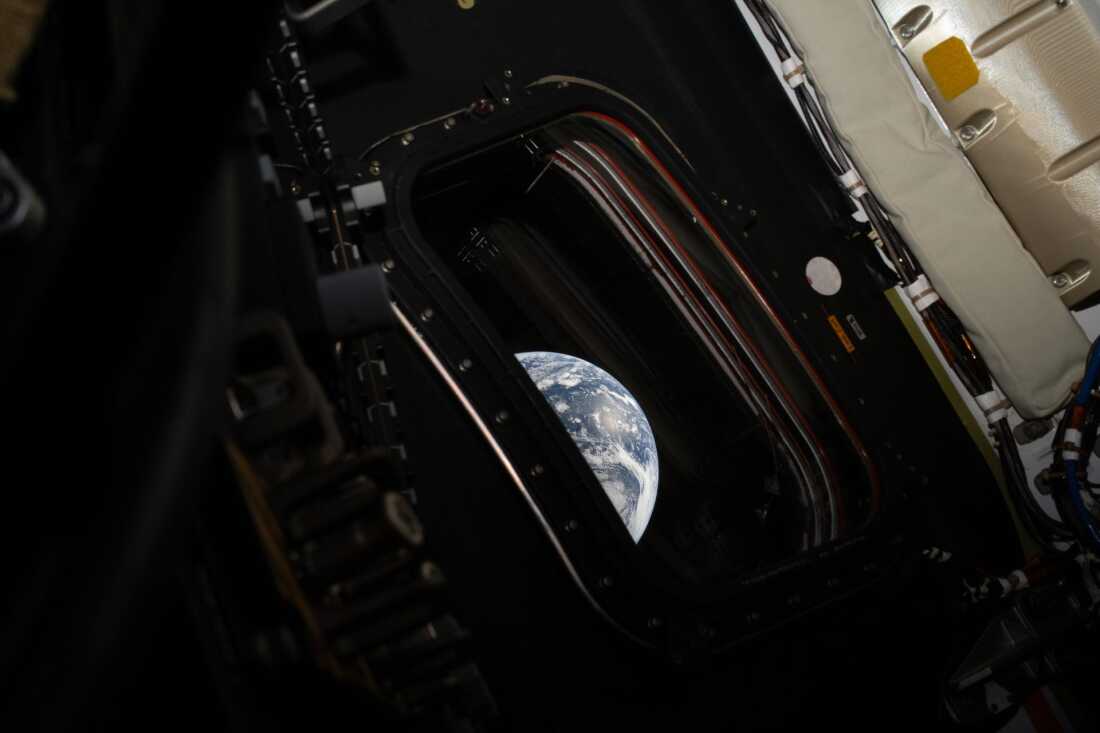
Inside the Orion capsule, the crew is adapting to life in deep space:
- Floating in microgravity
- Conducting system checks and navigation exercises
- Capturing photos and live downlinks back to Earth
NASA has also released images of astronauts peering out of Orion’s windows back toward Earth, offering a powerful visual of humanity stepping back into deep space.
Approaching the Moon’s Far Side
The mission is now approaching one of its most critical and symbolic milestones:
- A flyby of the far side of the Moon, a region never directly seen by most humans
- A trajectory that will take the crew farther from Earth than any humans in history
Among the most notable early images:
- The Orientale Basin, a massive lunar impact structure over 200 miles wide, now seen clearly by human eyes for the first time
Why Artemis II Matters
This mission is not just about reaching the Moon—it is about rebuilding humanity’s ability to operate in deep space.
Artemis II is the gateway to:
- Artemis III → First human Moon landing of the modern era
- Long-term lunar infrastructure and base development
- Future missions to Mars
It also marks several historic firsts:
- First woman to travel this far into space
- First person of color to orbit the Moon
- First Canadian astronaut on a lunar mission
We’re All Watching, and Again Dreaming For What’s Next
What we are witnessing is not just a mission—it is a reawakening of human ambition.
For decades, space exploration has been robotic, distant, and observational.
Artemis II changes that.
It brings back:
- Human perspective
- Human storytelling
- Human risk
And perhaps most importantly, it brings back belief.


